

Our solutions in actions
Impulso portal
Prioritization lists for health teams
A digital platform created to tackle one of the greatest challenges facing Brazil's public health system (SUS): ensuring that those who need it most receive preventive care at the right time. Our solutions transform public health data into actionable information that saves lives, enabling public health teams to identify risks early and act before conditions worsen.
By turning complex data into clear priorities, we help health teams deliver the right care to the right people at the right time, already supporting improved health outcomes for thousands of patients.
-
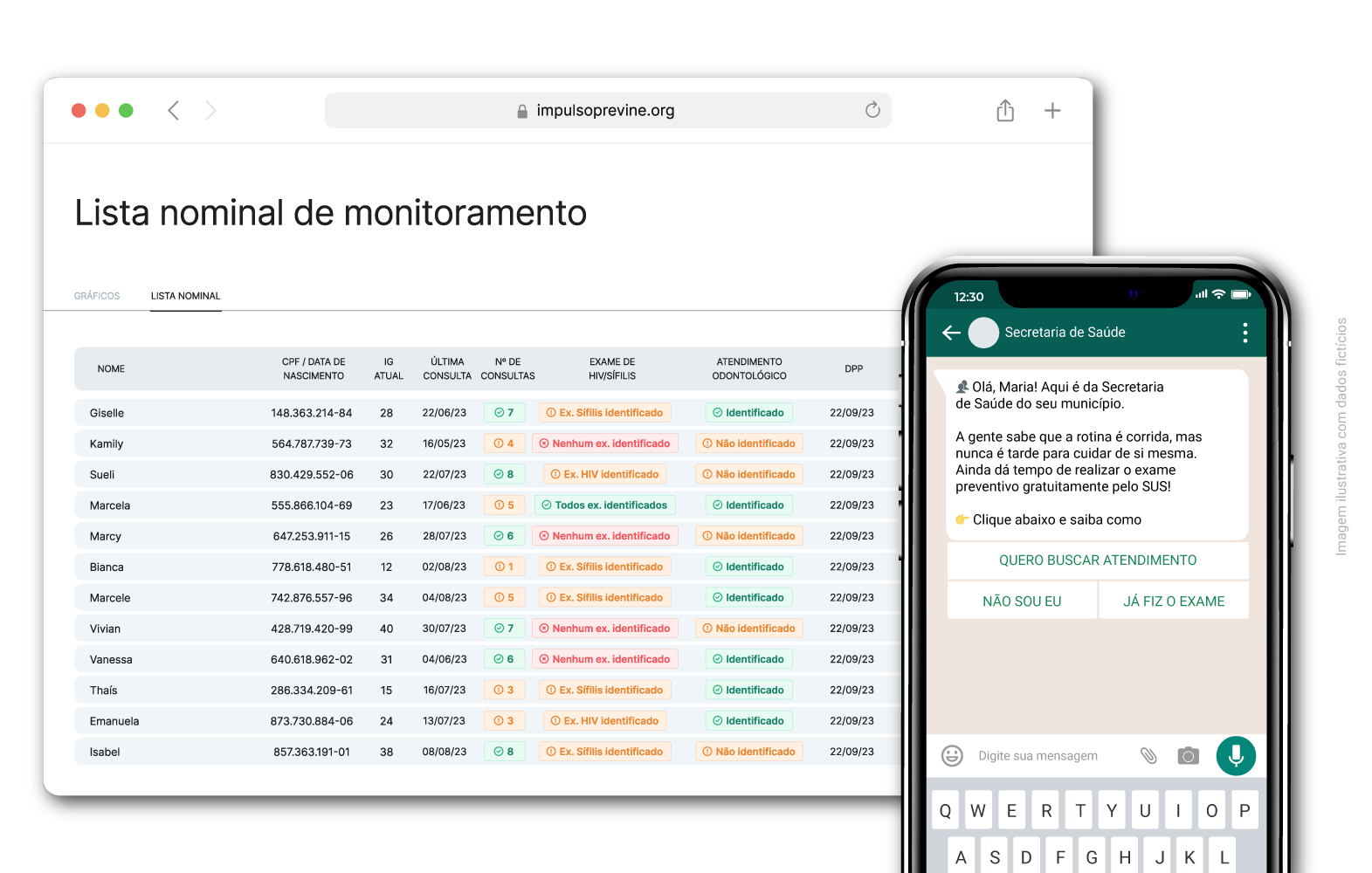
Through a secure login, health professionals in partner municipalities access tools that visualize data they already send to the Ministry of Health. While this data officially exists, it is often not made available in an accessible way to guide day-to-day actions.
Our platform organizes this information into clear, actionable nominal lists, allowing health teams to instantly see, for example: which children are due for vaccination, which women need a preventive screening for cervical cancer, which pregnant women need to attend their prenatal consultations, or which people with diabetes or hypertension are overdue for routine follow-up care.
-
In addition to access to the platform, partner municipalities receive ongoing support from ImpulsoGov’s health specialists. This includes strategic guidance, regular informational content, and opportunities for knowledge exchange between municipalities through shared learning spaces and events.
-
The solutions have already been implemented in over 330 cities. In just one year, with the support of the platform, more than 69,000 people with hypertension were actively monitored, and over 1,500 pregnant women received comprehensive prenatal care.
Thanks to ej-technologies for the freeinstall4j, the multi-platform installer builder license.
Citizen Messaging System
The Citizen Messaging System is a feature of Impulso Previne that uses automated mobile messages to increase adherence to preventive exams and follow-ups for chronic conditions. Messages are delivered in a controlled, phased approach using text, audio, and images, and are designed using behavioral science principles to encourage timely action.
-
The core purpose is to connect health teams directly with patients who are overdue for care, reinforcing preventive health actions and encouraging adherence to essential exams and appointments.
-
After identifying patients who are overdue for preventive care through the prioritization lists, the system contacts them via WhatsApp, a messaging app installed on over 98% of smartphones in Brazil. Automated messages help patients confirm or schedule appointments with their local health teams, while completion rates are tracked to measure impact and continuously improve outreach strategies.
-
Results show the effectiveness of direct, timely communication. In cities using the tool, the automated messaging system has led to a 147% increase in the completion of preventive screenings, showing a significant and direct impact on community health.
Mental Health for All

Our model is built on three core pillars:
Evidence-Based Training

Equipping professionals such as nurses and community health agents with the skills needed to provide primary mental health care using a proven, WHO-recommended methodology.
Sustainable Integration

Providing ongoing support to help health units embed this mental health service into their daily workflows, ensuring it becomes a sustainable part of their community care.
Quality and Symptom Monitoring

Ensuring the quality and effectiveness of care through expert-led supervision and continuous monitoring of patient progress.
Once trained, professionals receive ongoing supervision and practical tools to monitor patient progress, while municipal health managers are supported in integrating the service into local care routines.

Depression affects nearly 9 million people in Brazil, yet most public services are focused on severe cases. This creates long waiting lists and leaves many people without timely or appropriate care for common mental health conditions.
Grounded in international evidence, this approach brings mental health care closer to where people live — making it more accessible and effective.
The results speak for themselves: patients treated through the project have shown, on average, a 50% reduction in depressive symptoms. By transforming everyday health services into a gateway for mental health support, this model offers a replicable path forward for other countries facing similar challenges.
Read about our past projects

Public Management Support
Public Management Support was a mentoring program implemented by ImpulsoGov in collaboration with Instituto Votorantim. The initiative was designed to strengthen the capacity of local governments to manage frontline public health services, helping ensure more effective and reliable care for the population.
Over time, the program evolved to focus increasingly on improving service quality, streamlining local health management, and driving measurable improvements in community health outcomes.
-
The main goal of Public Management Support was to improve the quality and effectiveness of local public health services, contributing to better health outcomes and quality of life for the population.
To achieve this, the program followed a structured approach aligned with the real-world challenges faced by participating municipalities. It drew on proven strategies for strengthening community-level care, combined with insights gained through years of close collaboration with local health managers and frontline professionals.
By supporting these local teams, Public Management Support helped make healthcare more accessible, continuous, and responsive to people’s needs—especially in prevention, early diagnosis, and the management of long-term health conditions.
-
The program was delivered through a seven-month mentoring cycle, with weekly online meetings involving all participating municipalities.
Its methodology, implemented by ImpulsoGov’s team, followed a clear structure focused on improving how local public health services were planned and delivered.
Key topics covered included:
Monitoring and use of quality indicators
Organization of day-to-day operations of local health teams
Design of care strategies for priority groups, such as people with hypertension, diabetes, and pregnant women
Through structured mentoring and tailored support, Public Management Support helped municipalities strengthen health management practices, improve service delivery, and achieve better results for their communities.

Recife Primary Health Care Support Project
-
The Recife Primary Health Care Support Project was an initiative designed to help local health professionals improve the quality of citizen registries, addressing errors, outdated information, or missing data that made it difficult to identify individuals and deliver effective care.
Recife is a large city in Brazil with a population of nearly 1.5 million people. This free initiative included a digital tool to support community health workers in updating registry data, along with training and engagement through educational materials and local events.This free initiative involved the provision of a digital solution to support community health agents in correcting these inconsistencies, alongside training and engagement efforts through materials and events.
-
Team activation: Introduction of the project to local health teams, either online or in person.
Transition group: Creation of a WhatsApp group for ongoing guidance and training.
Working group: Selection of pilot teams to test the digital solution, with feedback loops and monitoring.
Mobilizers: Engagement of local professionals — including clinic managers and community leaders — to ensure sustainability.
ImpulsoGov collaborated with Recife’s Municipal Health Department throughout the initiative to monitor its impact and continuously improve the digital tool. As a result, the city now benefits from more accurate registries, which strengthen public health management and improve service delivery.
-
The project focused on correcting inconsistencies in citizen registries within the public healthcare system, improving follow-up and continuity of care for the population.
In the early stages of the partnership with Recife, inaccurate or incomplete data was identified as one of the main challenges facing local health management. Since these registries are foundational to nearly all healthcare actions, improving their accuracy became a key priority.
-
Updating individual records—such as addresses and phone numbers—was critical to:
Help community health workers track and reach patients, notifying them about appointments, exams, and vaccinations
Improve monitoring of potential communicable diseases and ensure a faster response from health teams
Strengthen the connection between residents and healthcare professionals, supporting more continuous and personalized care
The project has already delivered meaningful results for the people of Recife: it doubled the likelihood that a person would be able to schedule a hypertension-related appointment and quadrupled the chance of receiving a home visit from a healthcare worker.
With the project’s completion, Recife now benefits from higher-quality citizen registries, leading to more efficient healthcare management and expanded access to services for the population.
Mental Health Indicators Platform

-
The Mental Health Indicators Platform is a digital tool designed to support the management of mental health services within Brazil’s public healthcare system.
Using publicly available data, the platform offers a clear overview of mental health services in each city—including care provided by the specialized mental health network and how it connects to other parts of the local health system.
-
The platform’s main goal is to make mental health data more accessible and actionable for public health professionals. By organizing and visualizing key information, it helps local teams monitor service delivery and identify opportunities to improve care for people with mental health needs.
-
In many cities, health managers have limited access to reliable data on mental health services—such as how many people are being treated, or whether they are receiving follow-up care after a crisis.
The platform helps uncover service gaps and inform better decision-making. In the city of Aparecida de Goiânia, for example, data from the platform showed that many people hospitalized for mental health-related conditions were not receiving follow-up care afterward. In response, the city adopted a new care protocol to address this gap.